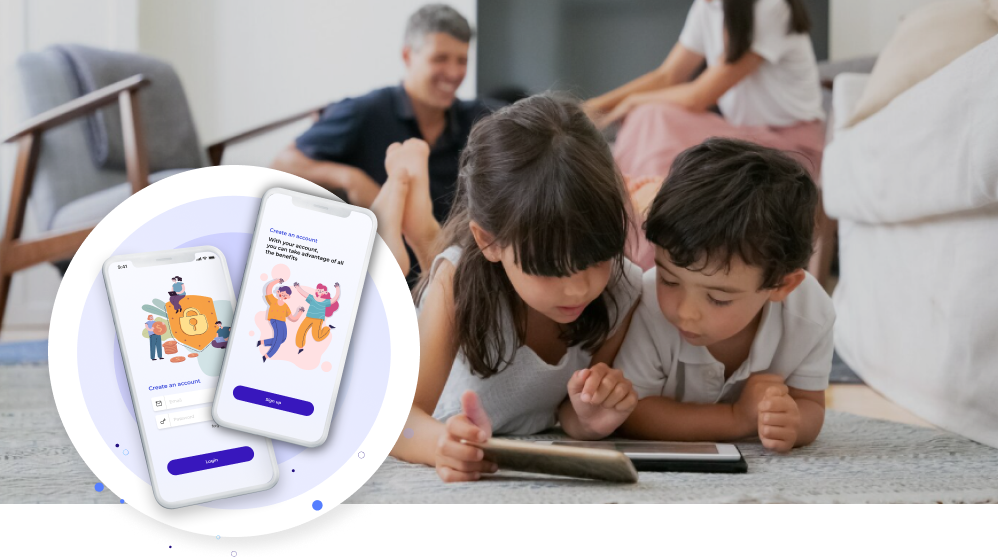
Turn money lessons into fun family activities : Manage your child’s finances by linking payment accounts and setting up automatic payments
Team : Product Designer, Project Manager, UX Designer, UI/UX Designer
My Role : Entire product design from research to conception.
Project Type : App design, UI/UX Prototype
Project Time : 2020 / 3 Months
Awards : Gold Award (a practical, bank‑partnered competition where we proposed innovative financial solutions)
Goal & Design Process
Goal :
In collaboration with a leading bank’s product development team, we created a digital financial service that addresses key pain points in existing parent–child accounts. Grounded in financial education, the project leveraged design thinking and user research to transform insights into engaging, interactive, and shareable product experiences.
Design Process :
We explored and validated financial service opportunities through four stages: Empathize, define, ideate, and prototype(concept development)—continuously assessing real user needs, solution feasibility, and validation methods.

Empathize
- Understand from user’s perspective
- Focus Group Interview
- Observed, Listened, Surveyed and gathered information

Define
- Define user personas and behavior
- Painpoints and needs

Ideate
- Design concept
- Explore possible user-friendly solutions
- Brainstorming

Prototype
- Create userflow from ideation to evaluation
- Main functions and prototype
Market research
Based on our market research, most parents hope their children can be exposed to financial education and saving plans as early as possible. Building on this key insight, we conducted a literature review and found that the University of Cambridge reports children have already formed concepts related to future financial planning by the age of seven.
However, a 2020 study by HSBC shows that most parents feel they are unable to provide consistent and effective financial education for their children, indicating that there are still significant gaps and opportunities in the market for parent–child banking accounts.
- 42% of elementary students and 65% of secondary students receive pocket money regularly, suggesting that as children grow older, they have more opportunities to learn about managing money.
- 95% of parents believe financial education should start young, only 21% feel confident in their own financial knowledge to answer their children’s questions.
- 59% of parents worry that their children spend money without thinking.
According to FINLEA’s 2017 survey on financial literacy among Taiwanese elementary and secondary school students (815 online responses), Taiwanese elementary students show a relatively strong understanding of saving and a high willingness to save on their own.
56%
Children want to learn what to consider before buying things.
46%
Children want to understand how to save and spend wisely.
61%
Children save up on their own for things they want.
88%
Children regularly save money.
70%
Children want to discuss money with their parents.
✺ Children are already actively exploring how to manage money—they want to learn both how to spend and how to save—but many parents lack the knowledge and tools to support this education.
According to the Financial Supervisory Commission (FSC), mobile payment transactions had accumulated to NT$503.2 billion by March 2020, as shown by the usage patterns of Generations X, Y, and Z.
- Generation X mobile payment usage rate: 73%
- Generation Y mobile payment usage rate: 76%
- Generation Z mobile payment usage rate: 84%

✺ Overall, mobile payment adoption among teenagers has reached a significant scale.
Interview to gather information
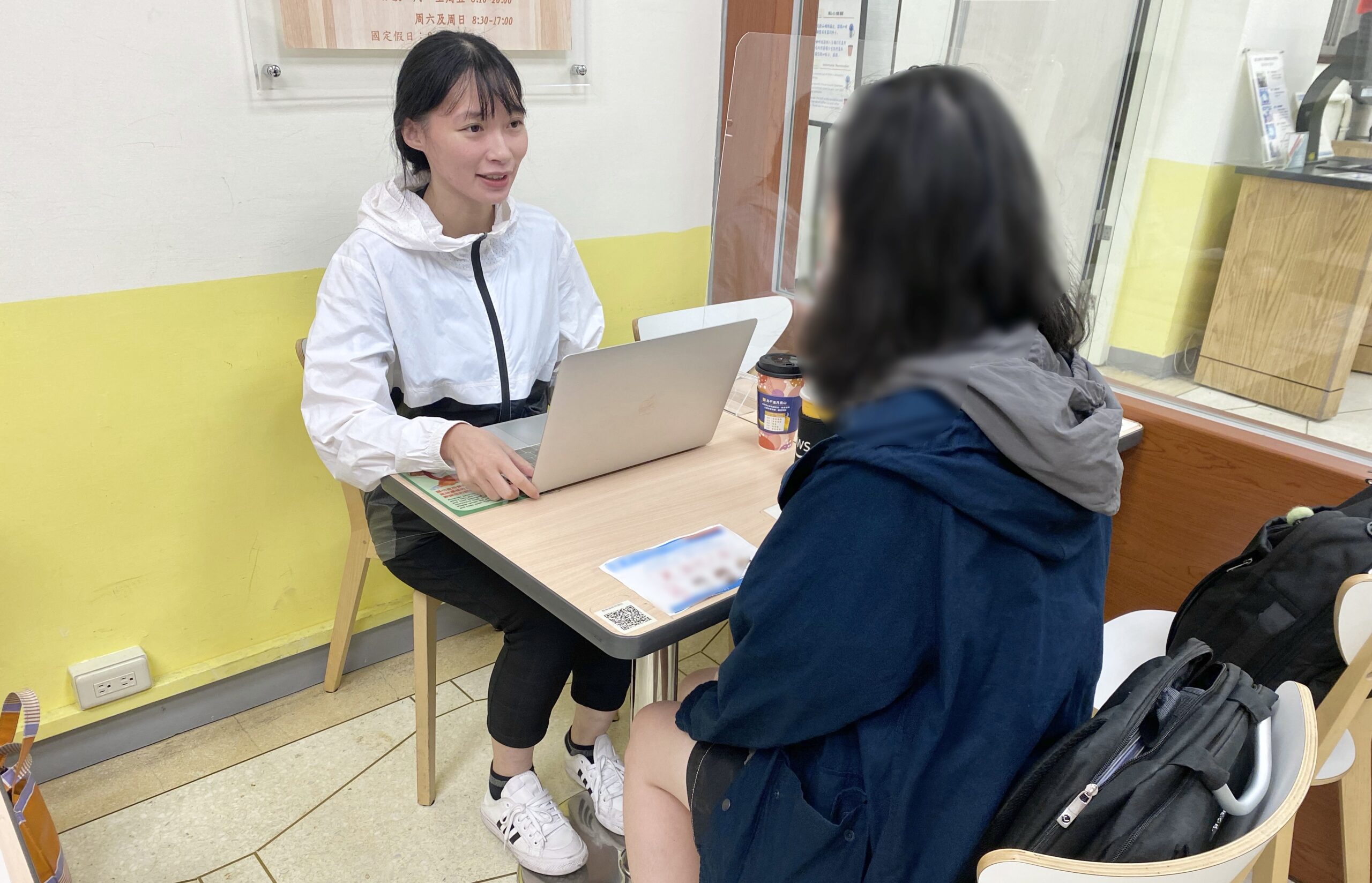
To better understand market acceptance, awareness, needs, and pain points surrounding parent–child accounts, interviews and an online survey were conducted, yielding 163 valid responses.
Rather than examining detailed product requirements, this preliminary research focused on identifying differences in financial attitudes and knowledge among parents and children from diverse family backgrounds.


Target audience
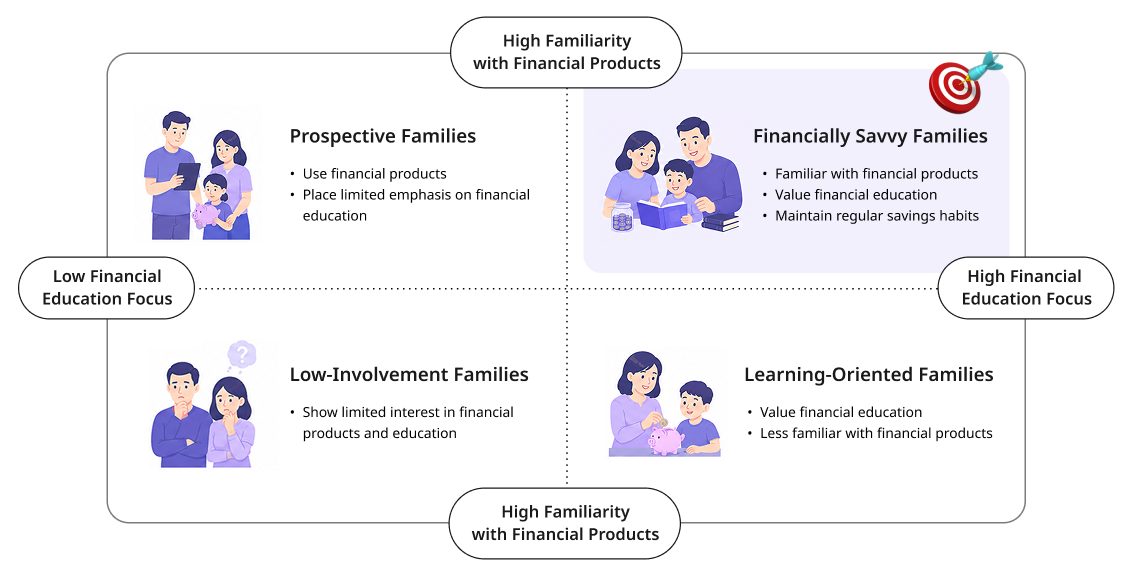
Using quantitative and qualitative insights from interviews and survey data, the primary audience was segmented into four quadrants, revealing the defining characteristics of the target users.
Families were segmented by their familiarity with financial products and emphasis on financial education, as these dimensions reflect their financial foundation and motivation to educate—helping identify the most promising target groups.
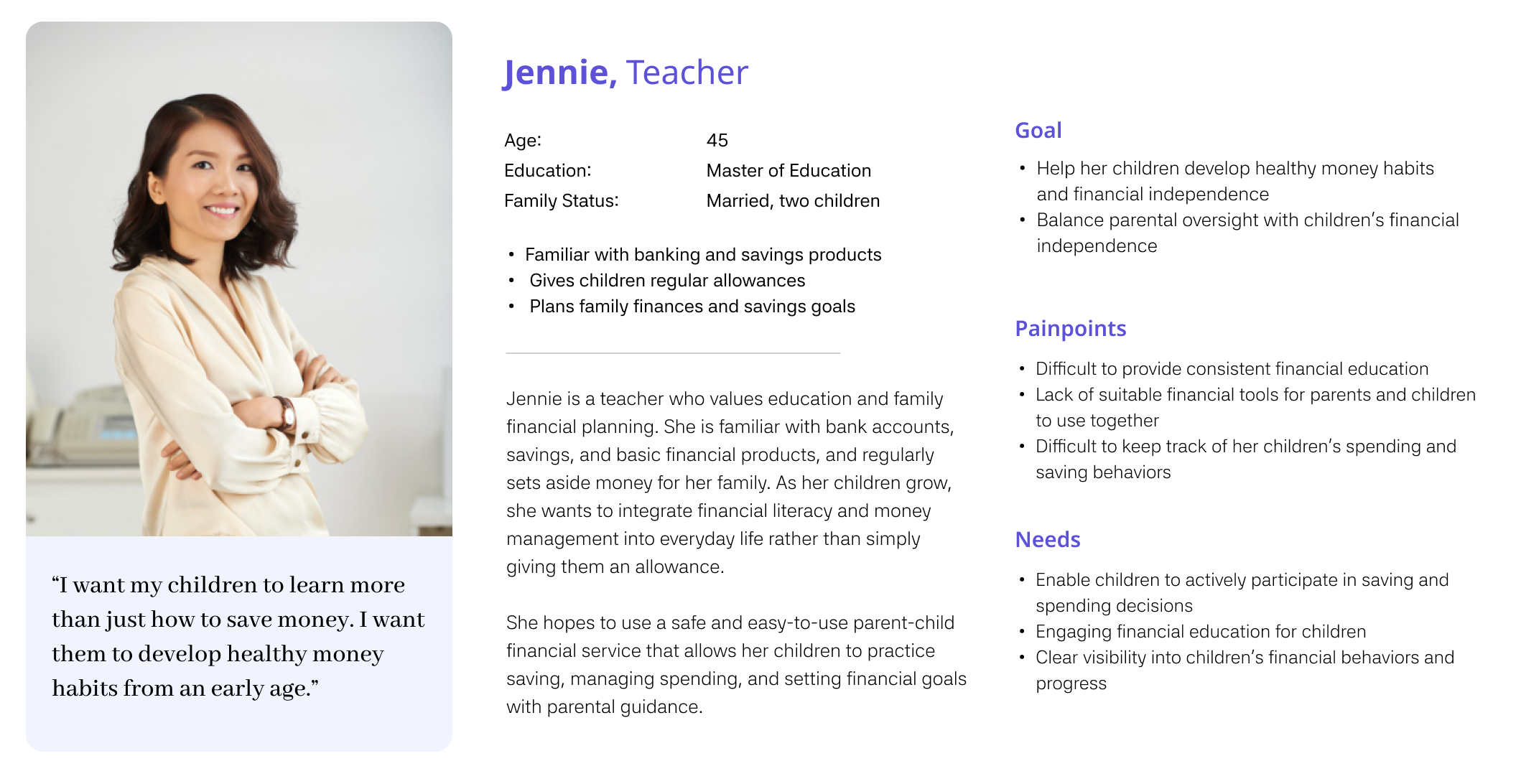
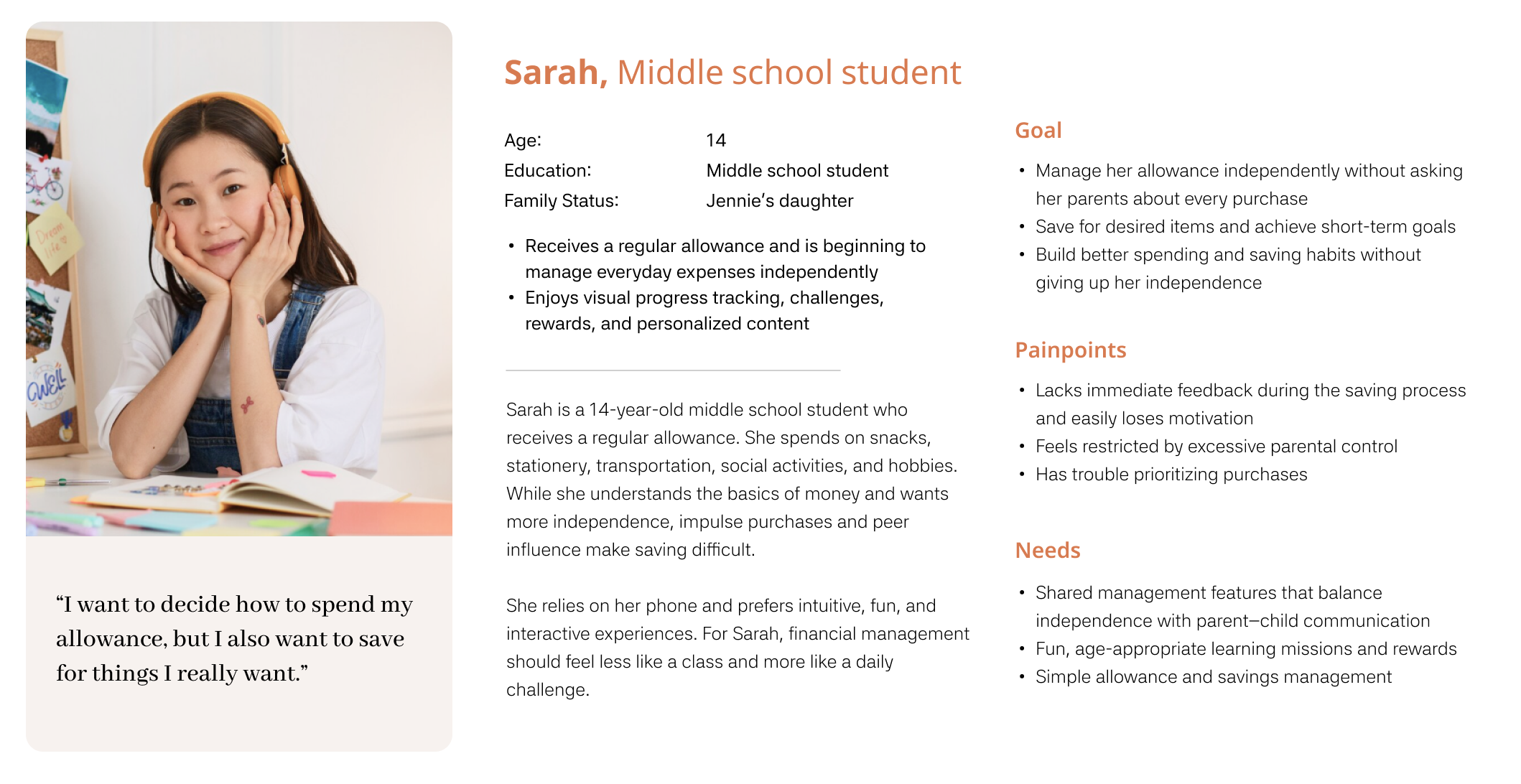
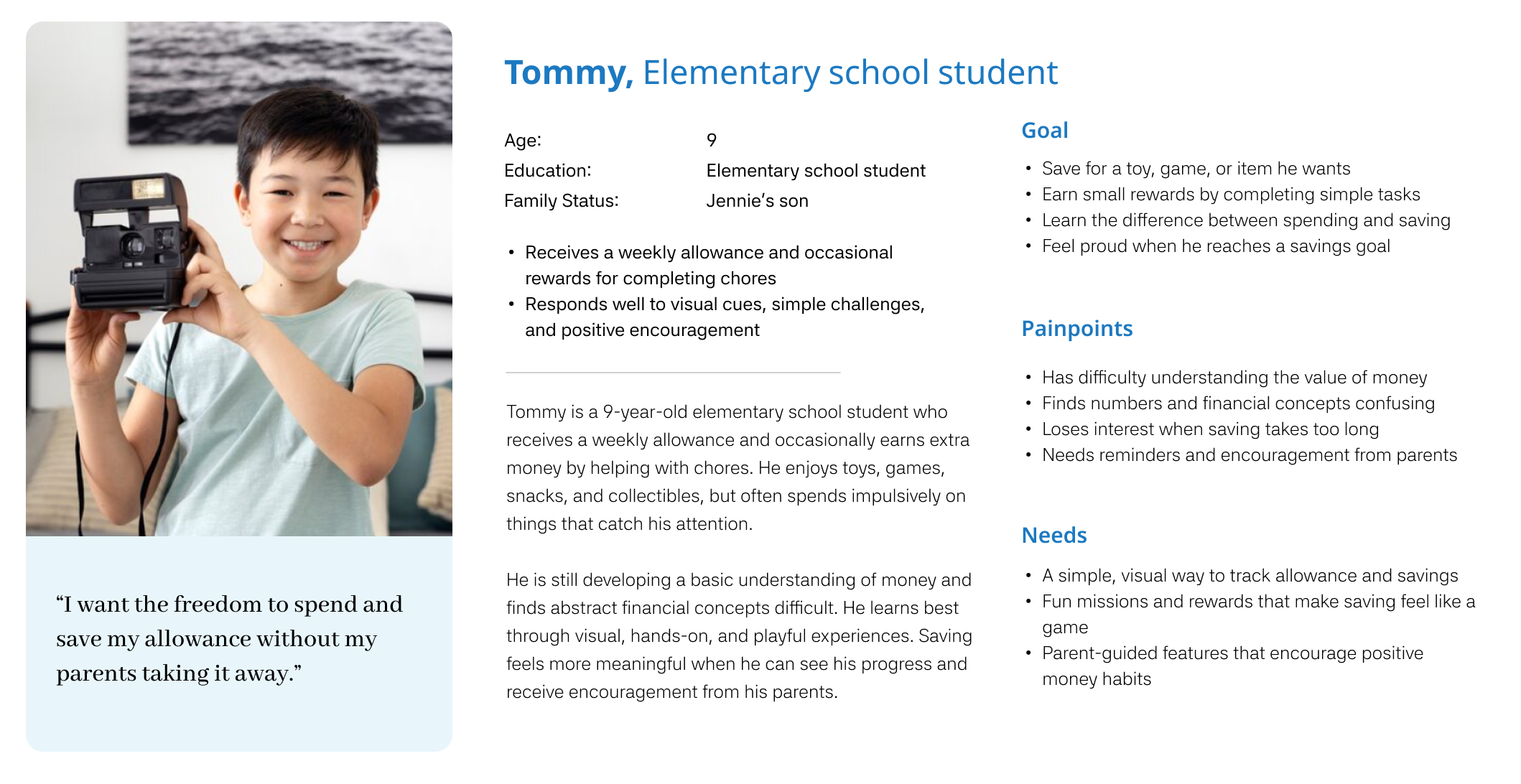
Three key personas were then developed—Jennie, a 55-year-old teacher; Sarah, a 14-year-old student; and Tommy, a 9-year-old student—to better understand core users and prioritize their needs.
User interview : Key insight
We interviewed three families representing the three personas to conduct an initial contextual analysis. By gathering perspectives from both parents and children, we identified their needs, pain points, and expectations around allowance management, saving habits, spending decisions, and financial education. The interviews focused on everyday situations and explored the balance between children’s independence and parental guidance.
Parent Interview Questions
- How is your child’s allowance given, managed, and used at home?
- What does your child usually spend their allowance on? Do they save regularly?
- How do you discuss spending, saving, or money with your child?
- What do you hope your child learns from managing an allowance?
- What challenges do you face when guiding or tracking your child’s spending?
- Have you used bank accounts, budgeting tools, digital payments, or finance apps for your child? What was the experience like?
- What problem would you most want a parent–child financial service to solve?
Child Interview Questions
- What is the hardest or least enjoyable part of managing your allowance?
- Do you need parental approval before spending? What purchases can you decide on yourself?
- How much freedom would you like over your allowance? When do you not want your parents to intervene?
- What features would you want in an app that helps you manage and build allowance-planning habits?
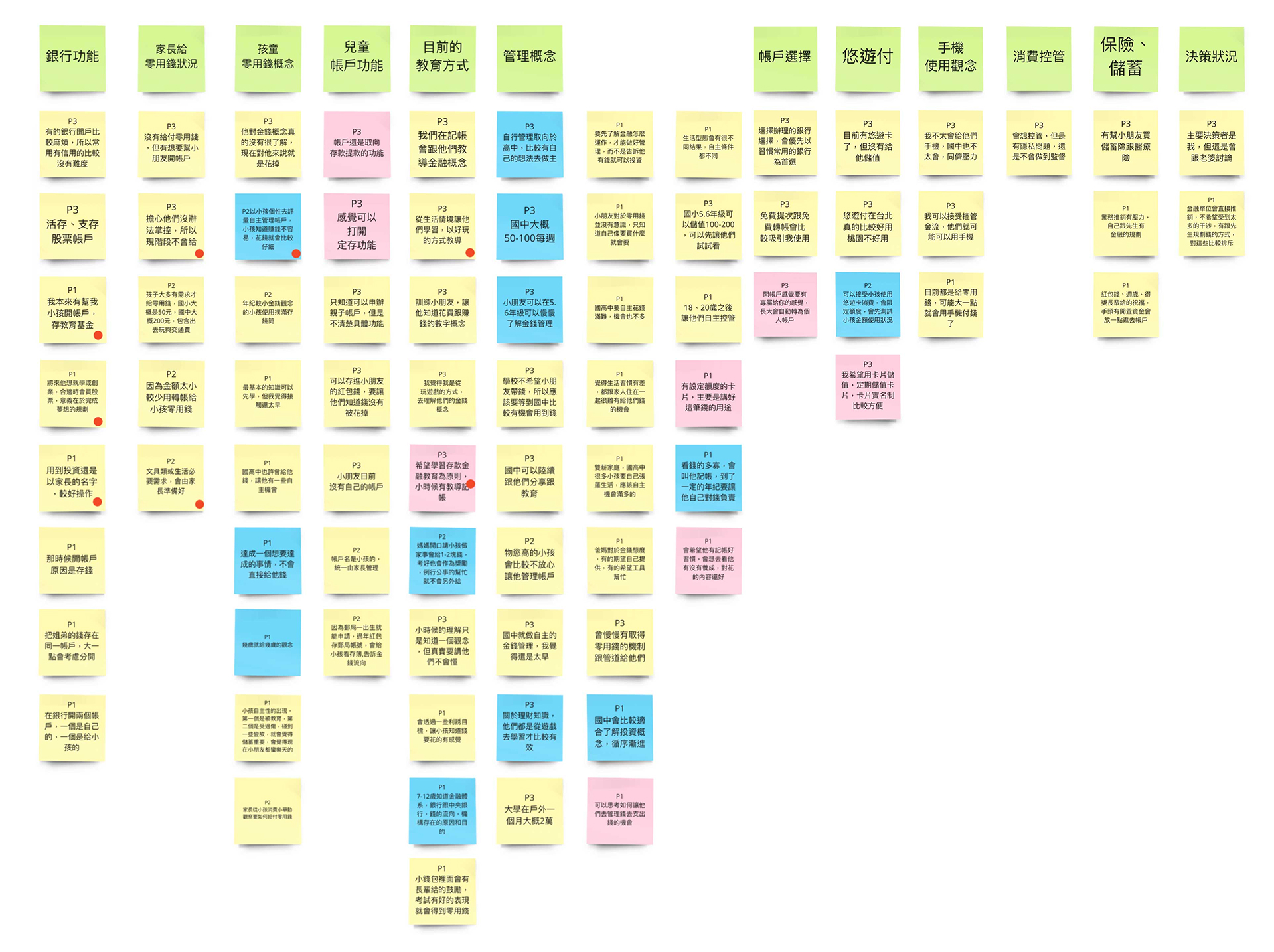
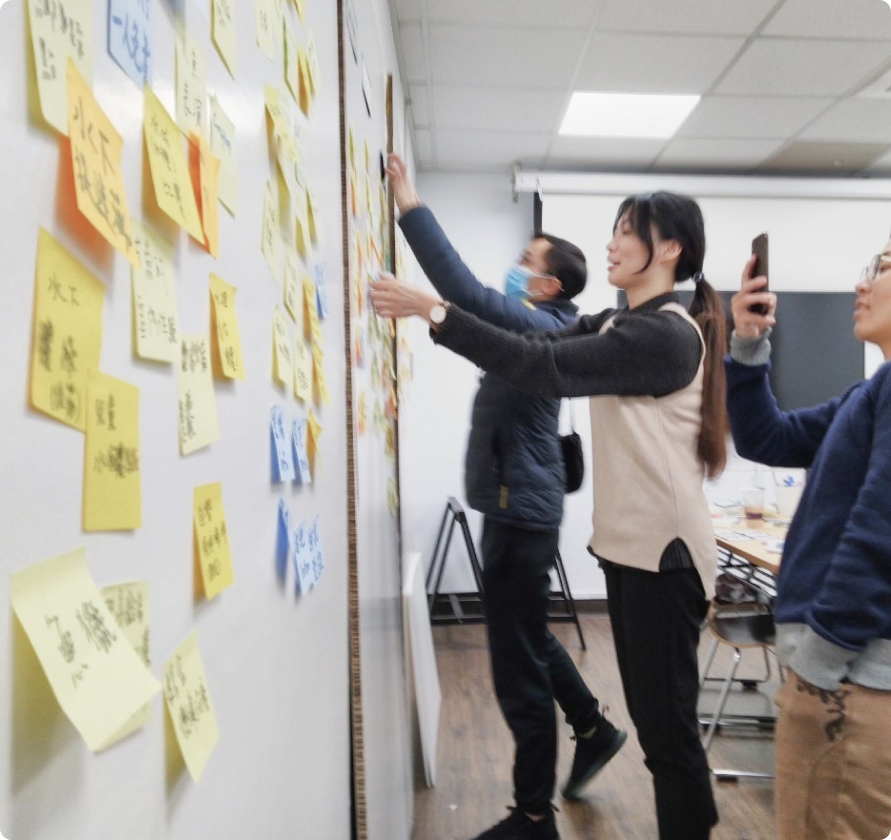
Interviews showed that parents often retain financial control in children’s early years, gradually increasing independence in middle and high school. Children, however, already want to take part in saving and spending decisions.
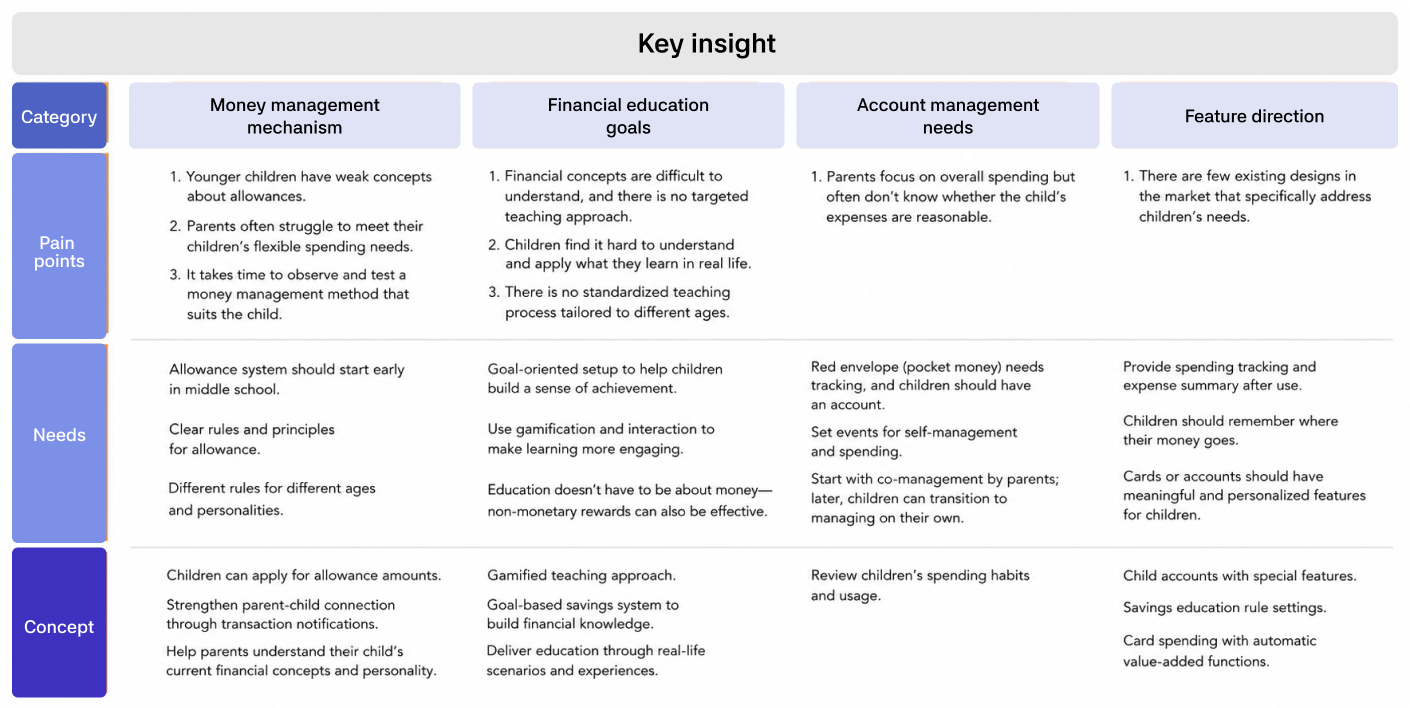
Therefore, the service should go beyond simply providing a “child account.” Through goal-based saving, spending tracking, and interactive financial education, it should create a shared space for parent–child management and learning—helping children gradually transition from being managed to managing their own finances.
Design concept
This project is a parent-child finance e-payment app offering dedicated experiences for both parents and children. Interfaces and features are tailored to different age groups and user needs, creating a new family-oriented financial experience.
We found that financial learning is a long-term process, not a one-time transfer of knowledge. Therefore, the design focuses on encouraging children to planning their finances, setting saving and spending goals, and reviewing their progress through everyday experiences.
Aligned with business goals, the product aims to foster long-term financial habits and education, building lasting relationships with users and ultimately converting them into future banking customers.
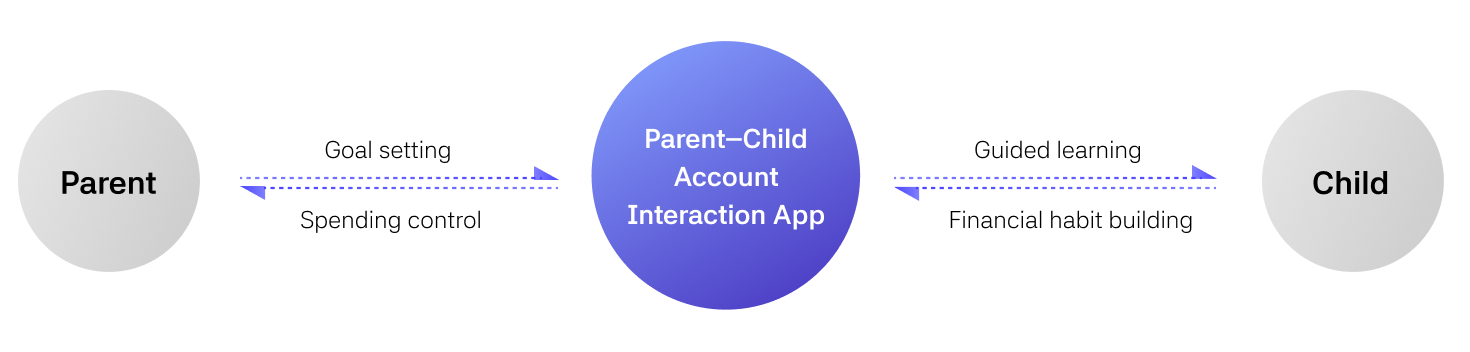
Interactive Family Financial Education: Independence, learning, and engagement.
The initial design concept integrates insights from user research and team brainstorming, translating the needs of parents and children into a phased parent–child financial service framework that serves as the foundation for future feature planning and experience design.
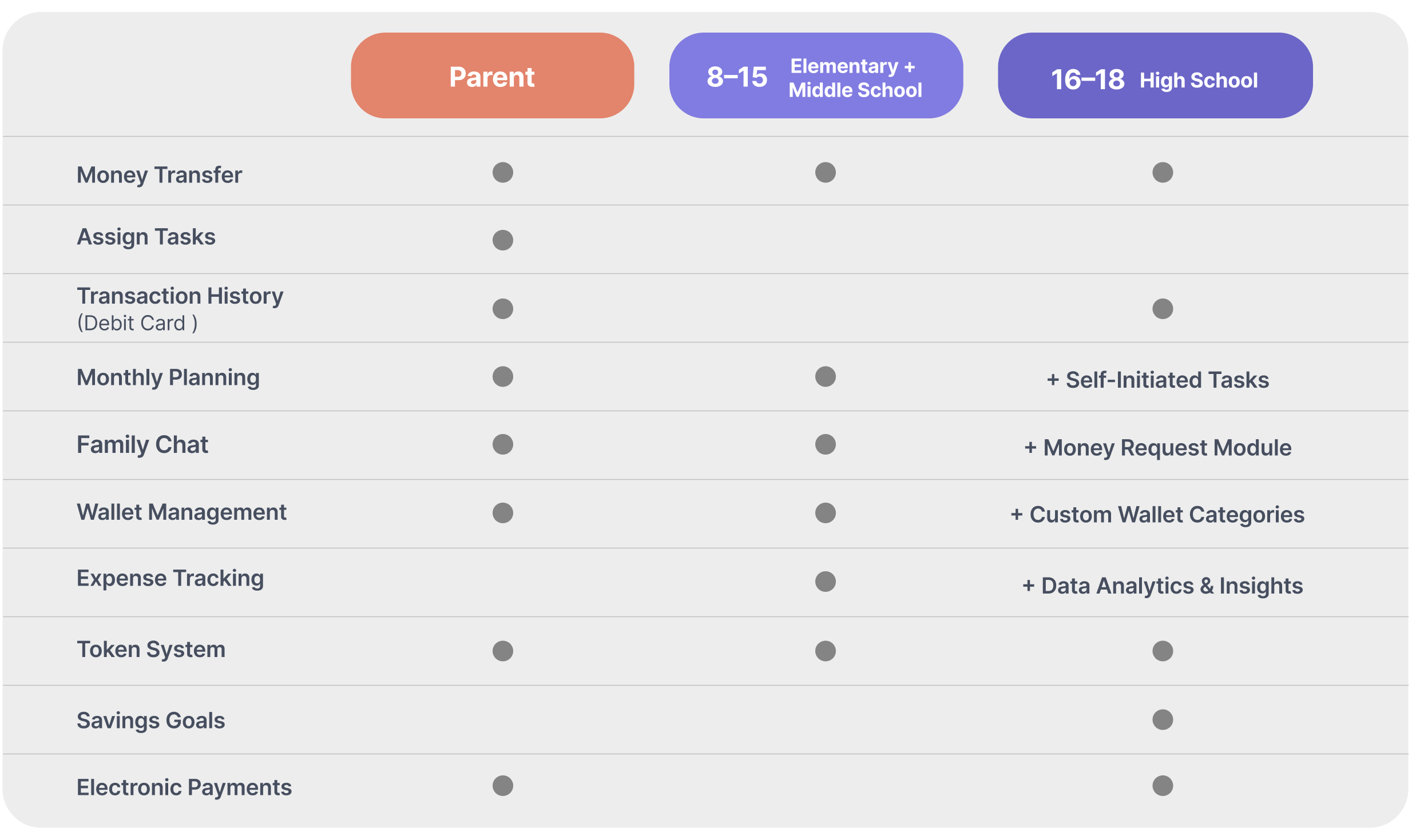
During ideation, we addressed the needs of both parents and children while considering age-based customization and progressive feature unlocks.
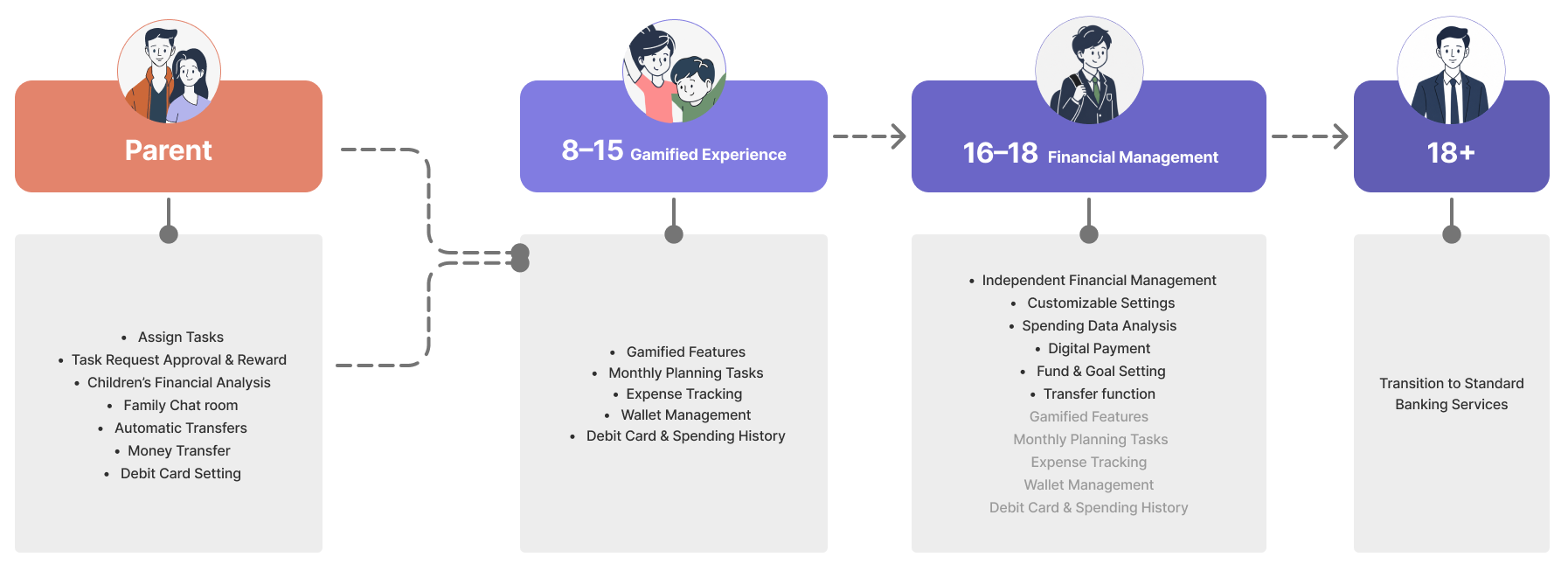
For elementary and middle school students, the focus is on habit formation, while high school students are offered more customized and advanced features. We have organized these into a feature matrix.
Ideate & Structure
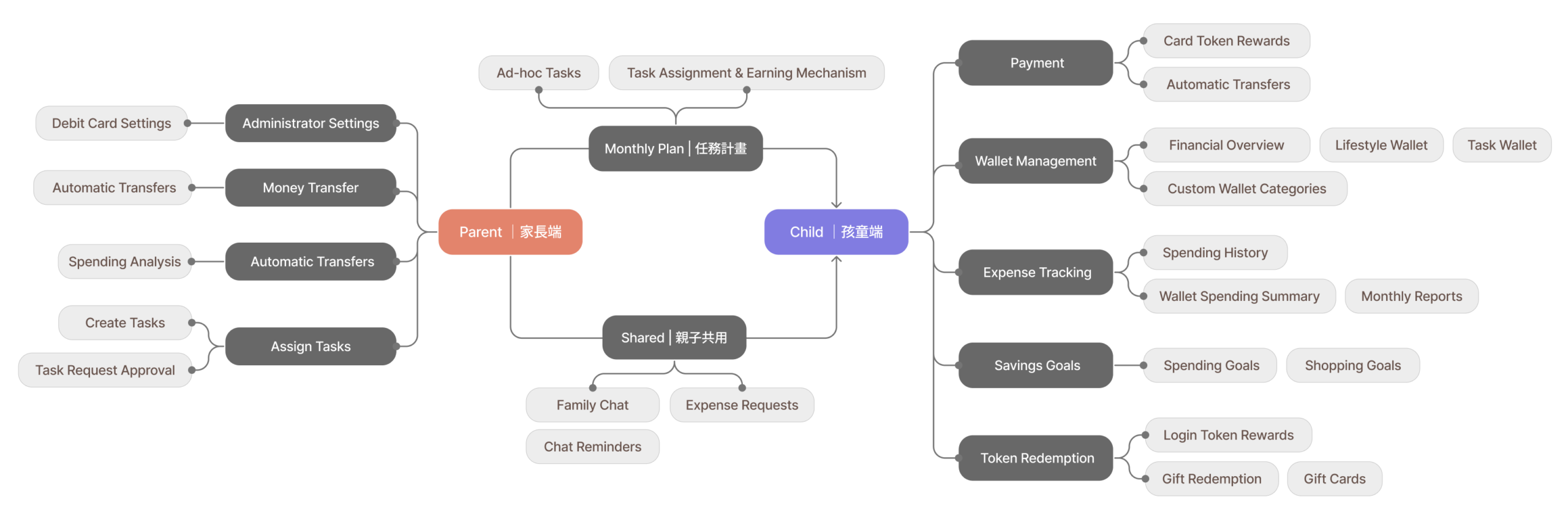
Based on the design concept, we organized the app’s core features around three perspectives: Parent, Shared, and Child.
A key feature is two-way parent-child communication and interaction, allowing parents to manage card allowances and transfers while guiding children through tasks to gradually build financial independence. It creates a family-centered financial experience that is both educational and engaging.
Prototype & feature
Together with another designer, I translated our research findings into wireframes and interactive prototypes, using tangible product experiences to bring our insights to life. We presented the concept to the bank team, successfully positioning the product as an innovative and breakthrough solution for family-oriented financial services.
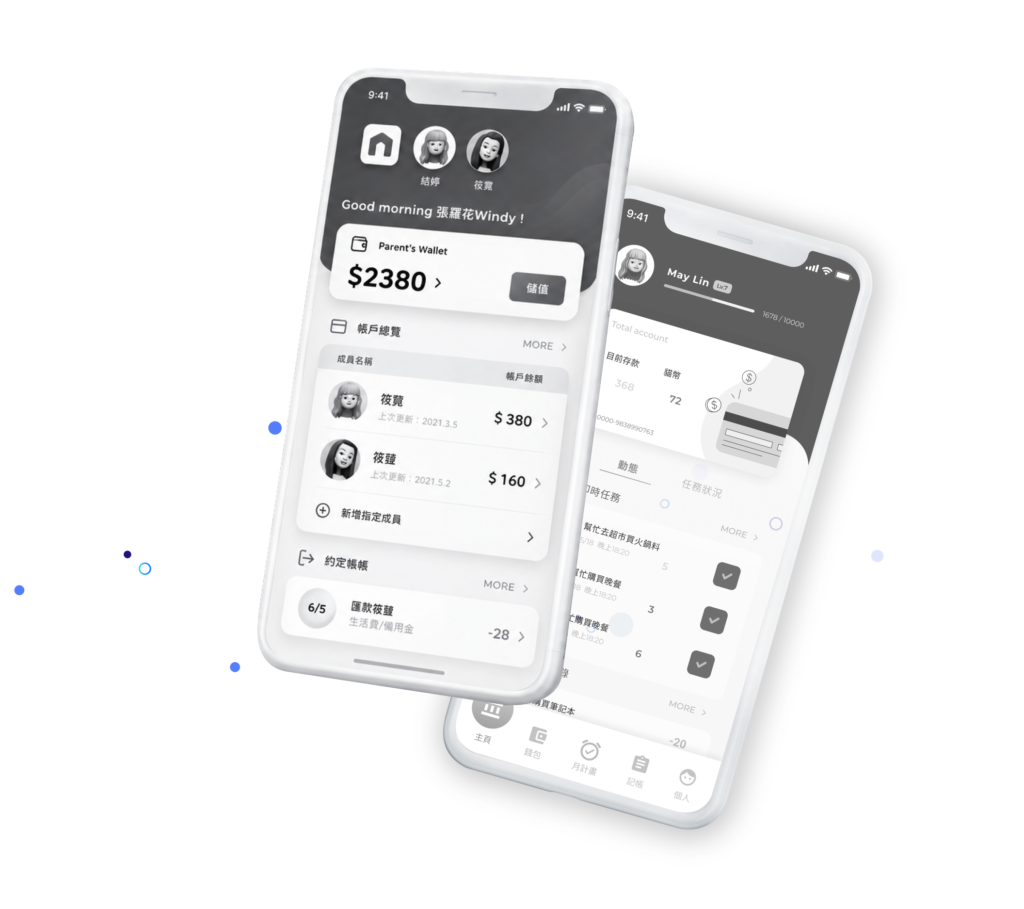
An e-payment app designed for parent-child financial management.
Designed for both parents and children, the app features TA-based interfaces tailored to different user needs, creating a new family-oriented financial experience.
(The prototype focused on highlighting the key design concepts)
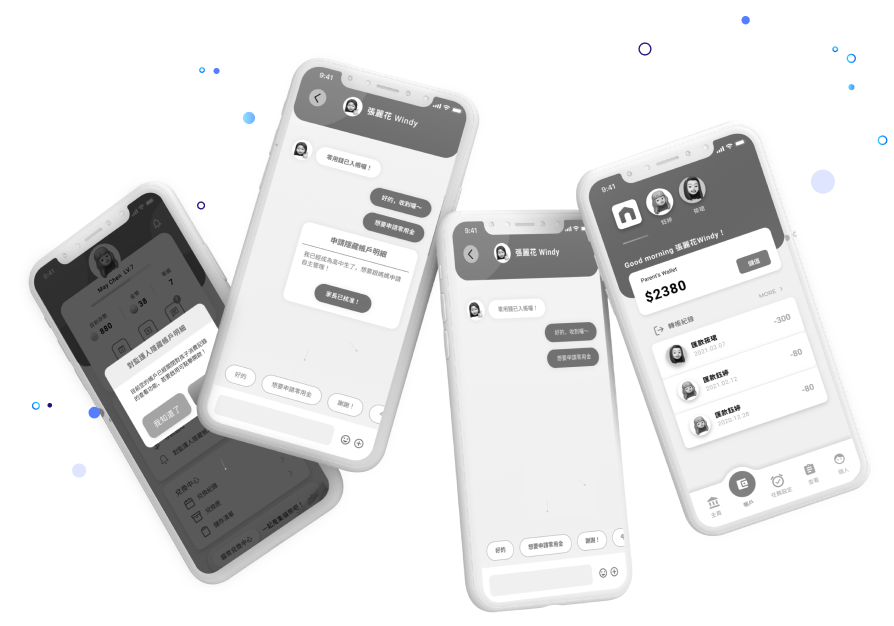
✺ Real-Time Family Chat
Enable financial communication and transactions in one place. When children need money, they can request it through chat, and parents can approve the request to trigger an automatic transfer to the child’s account.
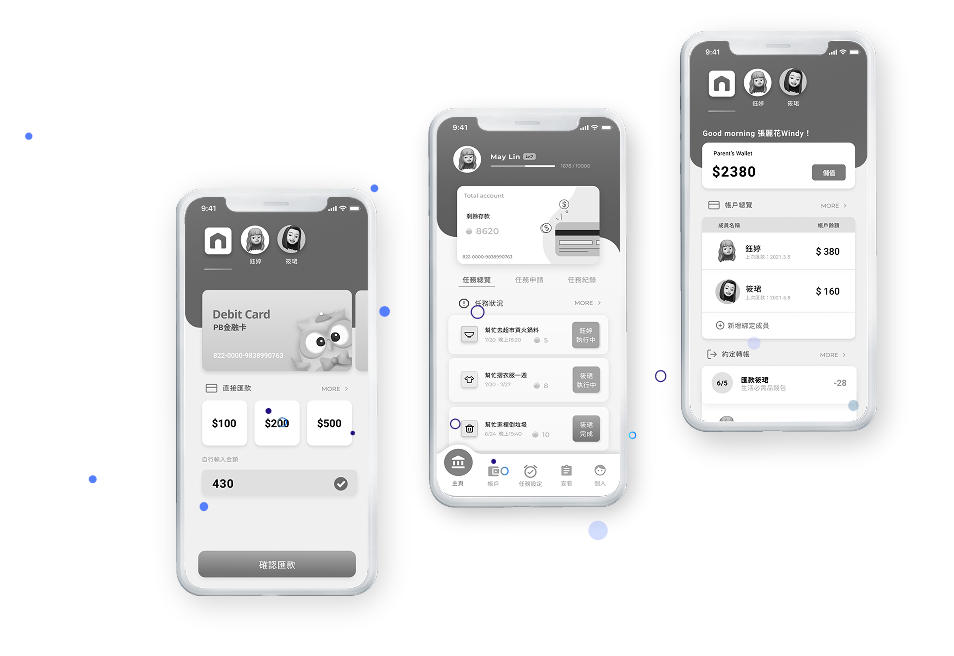
✺ Quick Fund Allocation & Savings Control
The parent management portal allows flexible account member setup and provides an overview of children’s card accounts. Parents can select a member to quickly allocate funds and easily manage savings and transfer limits.
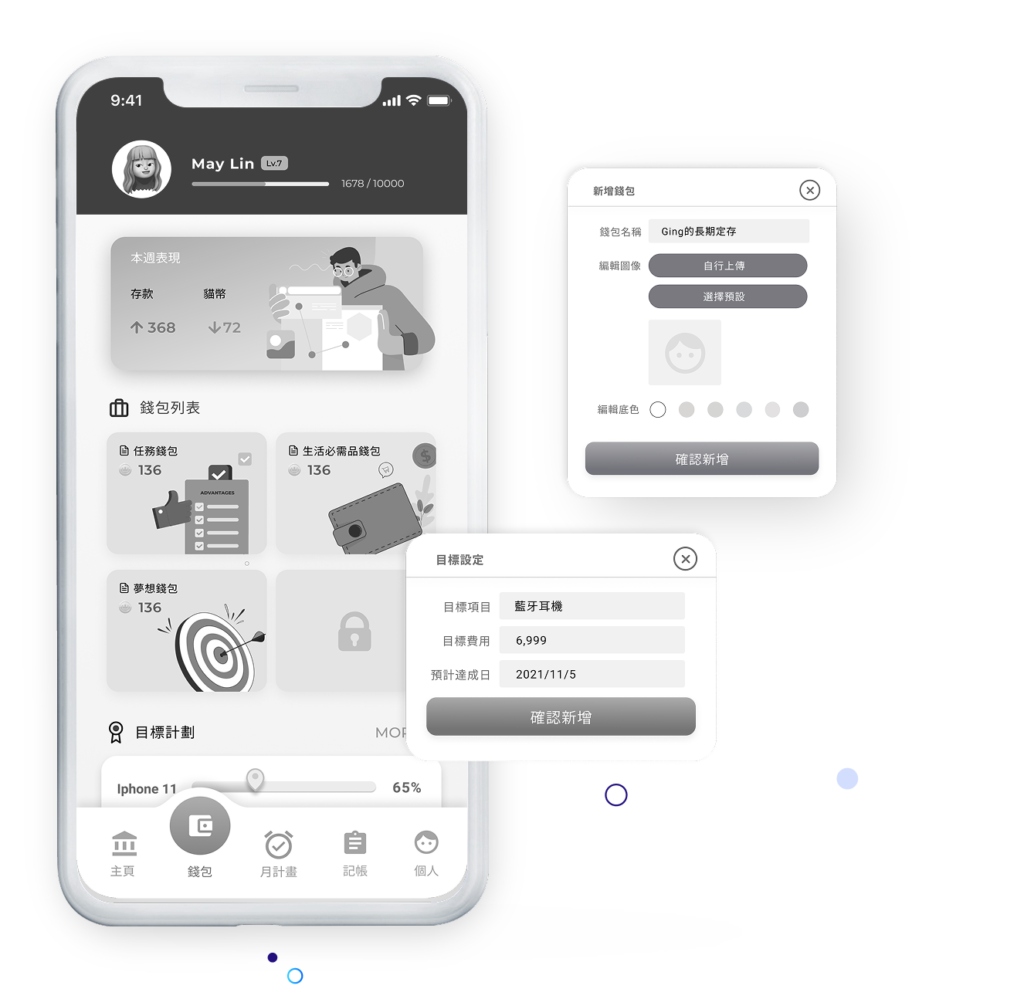
✺ Allowance Management, Expense Tracking, and a Multi-Wallet E-Wallet
Children can allocate deposits across different wallets and manage savings and spending based on personal goals. By tracking their cash flow, they can develop saving habits over time.
For high school students, a personal wallet feature is introduced to support more independent spending and savings planning, helping them build greater financial autonomy.
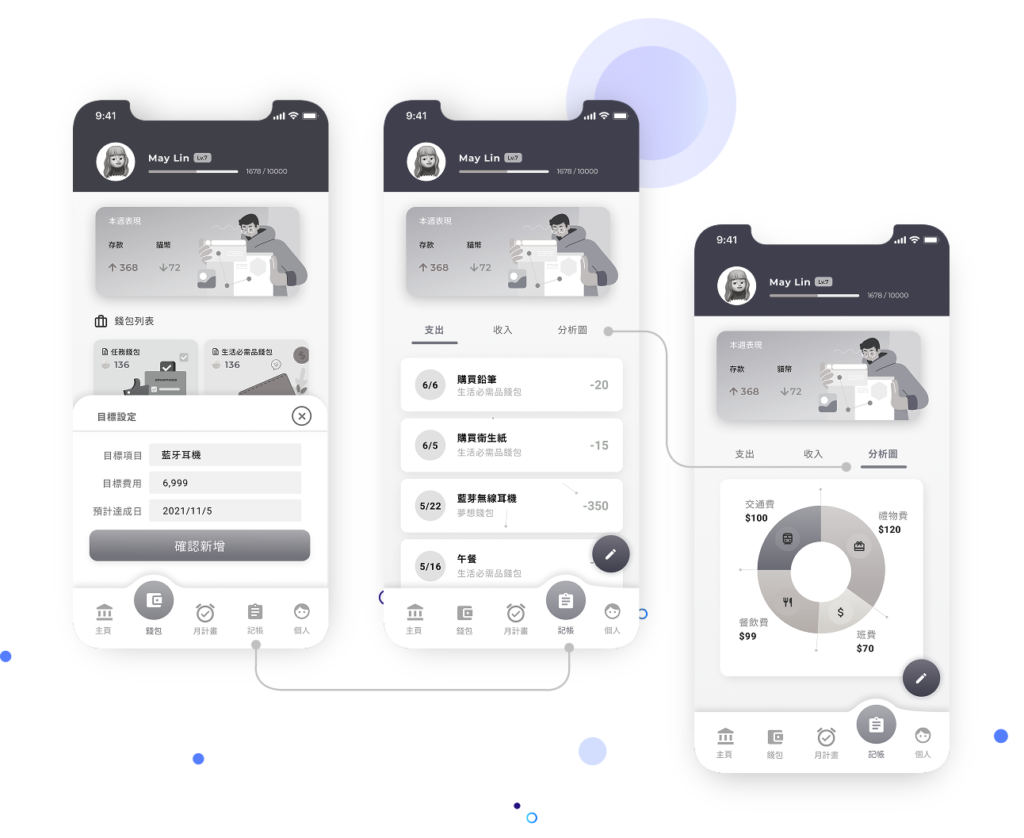
✺ Provides weekly spending insights and expense tracking, with personalized recommendations based on spending data.
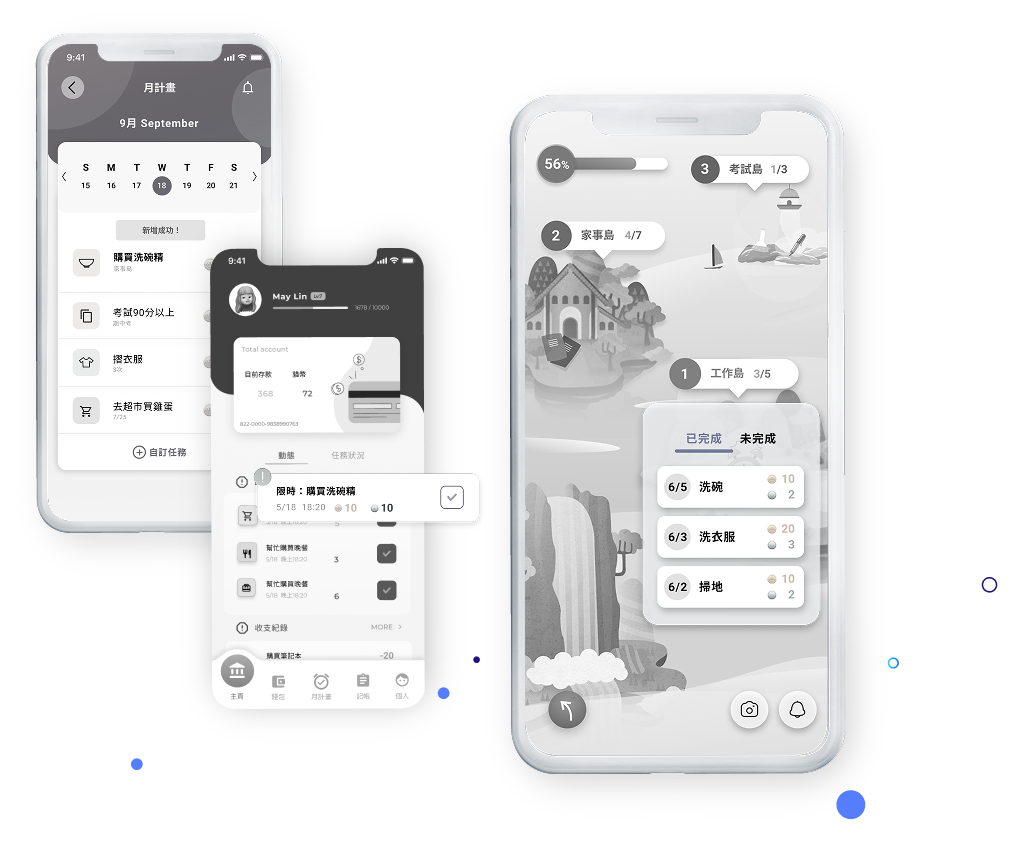
✺ Gamified Tasks and Allowance Rewards
The experience is structured around themed islands, each representing a different type of task. For elementary and middle school users, the system can include preset islands for chores, schoolwork, and exams, while parents can create custom challenges or assign everyday tasks.
By completing tasks, children earn allowances and in-app currency, turning daily responsibilities into a more engaging experience while encouraging positive parent–child interaction.
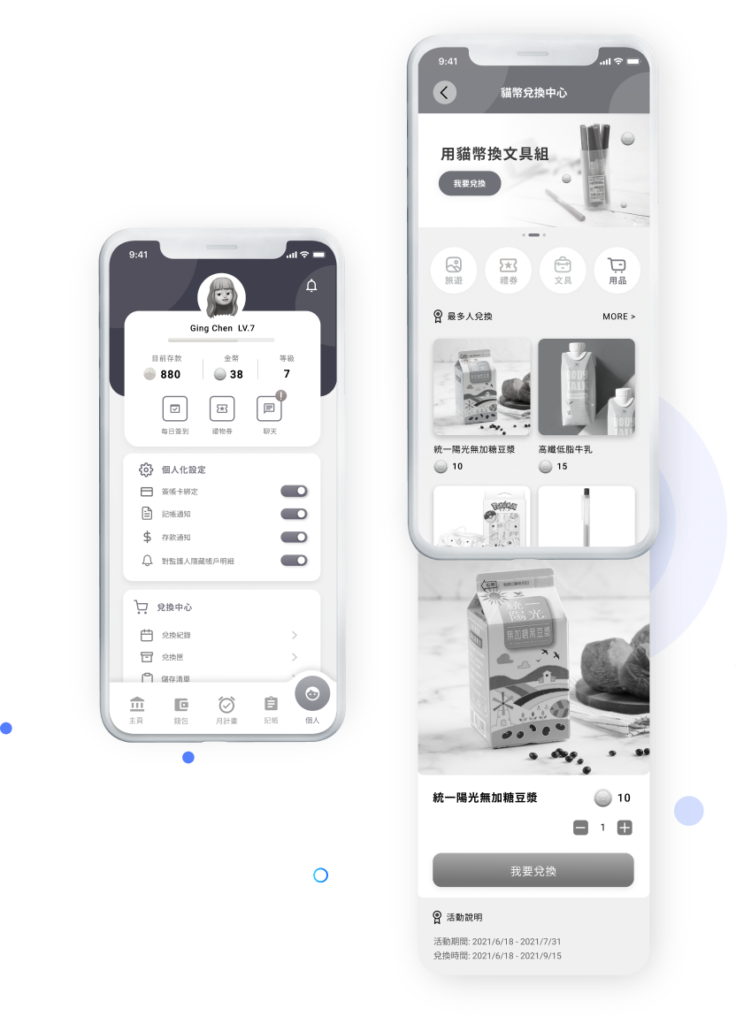
✺ Token Rewards Marketplace and Transaction Activation
Children can earn tokens through daily check-ins, completed tasks, savings goals, and special campaigns. These tokens can be redeemed in the marketplace for partner products, bank-related rewards, or discount vouchers, encouraging continued engagement while creating opportunities to activate future transaction services.

Design Verification
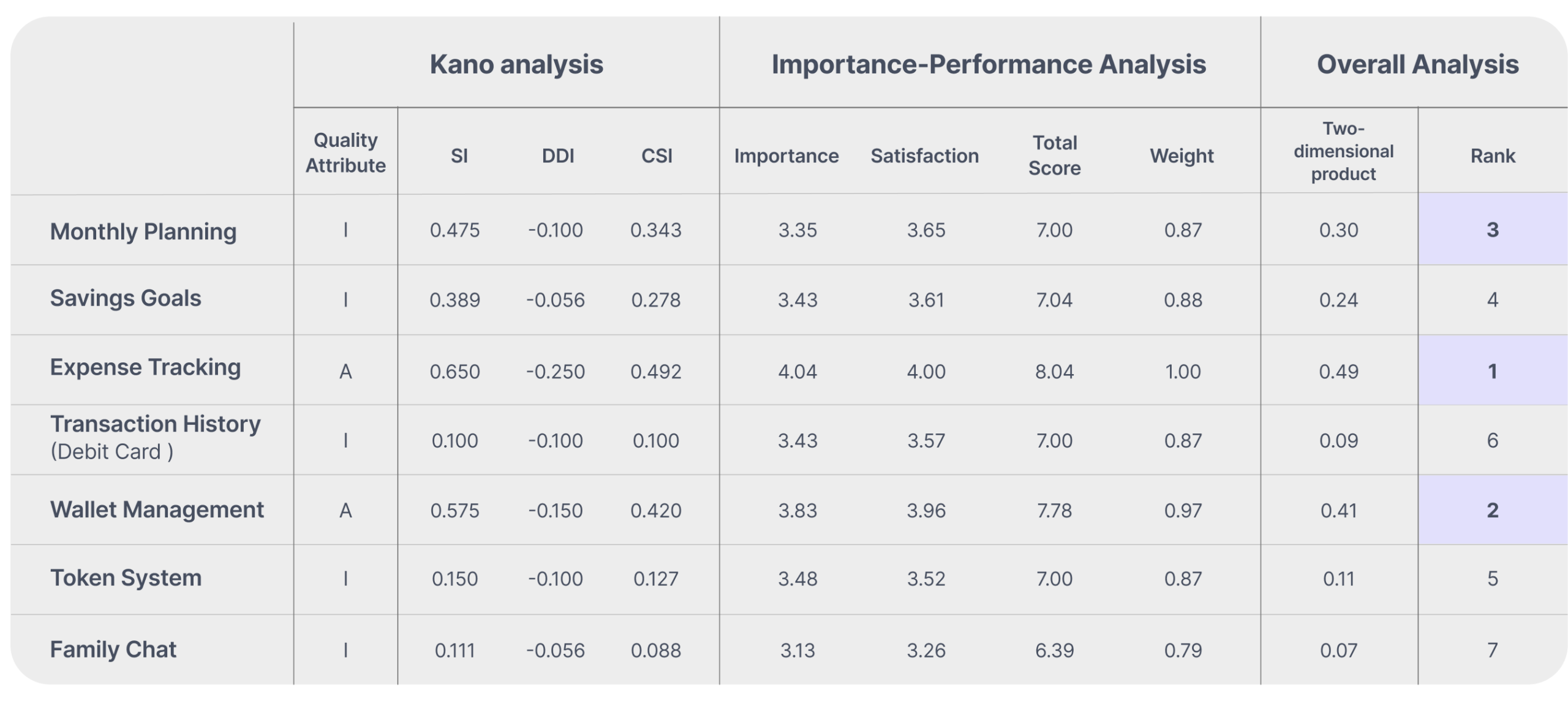
We gathered feedback from 46 parents on the design concepts. The results showed that “Expense Tracking & Insights” and “Self-Managed Wallets” were the most appealing, further validating the design direction and its alignment with market needs.